Spark AR Platform
The creator platform behind effects on Instagram, Messenger, and Portal
Spark AR was the platform that let anyone make AR for Instagram, Messenger, and Portal - hundreds of thousands of creators shipping effects to hundreds of millions of people, at a scale of billions of impressions a day.
My job was to identify which technologies out of R&D were the highest leverage for the platform, get buy-in, and then design how creators would actually wield them. Full-body tracking, world AR, and multi-participant effects all made that trip while I was there, working in tight cross-org collaborations with Instagram and Messenger to land them.
The product isn't the editor - it's what creators ship with it
A new runtime capability is worthless until a creator can wield it. For every technology we elevated out of R&D - body tracking, world tracking, multi-participant sync - my job was designing the bridge into the Spark editor: the mental model, the patching interface, the defaults, and the failure behavior a creator would hit on their first attempt.
Get an editor abstraction right and thousands of creators ship things you never imagined. Get it wrong and the capability dies quietly, no matter how good the underlying tech is.
Identifying platform opportunities
Full-body tracking, from research demo to effect type
R&D produces a steady stream of new capabilities, and they don't arrive labeled. Some look spectacular in a demo but can really only do one thing; others look unremarkable and turn out to be a whole category. Part of my role was that judgment: spotting the opportunities other people didn't realize were opportunities, and determining which technologies actually had legs once they were in creators' hands.
Full-body tracking for effects is one example of this kind of push. I worked across orgs with Instagram and Messenger to carry it from internal demo to supported effect type - designing how a creator binds content to a body without rigging knowledge, and what happens when tracking degrades on a mid-range phone in bad light.
Creators turned it into dance effects, costume try-ons, and full-body games - creating new content categories for the platform.
Bringing creators to the cutting edge
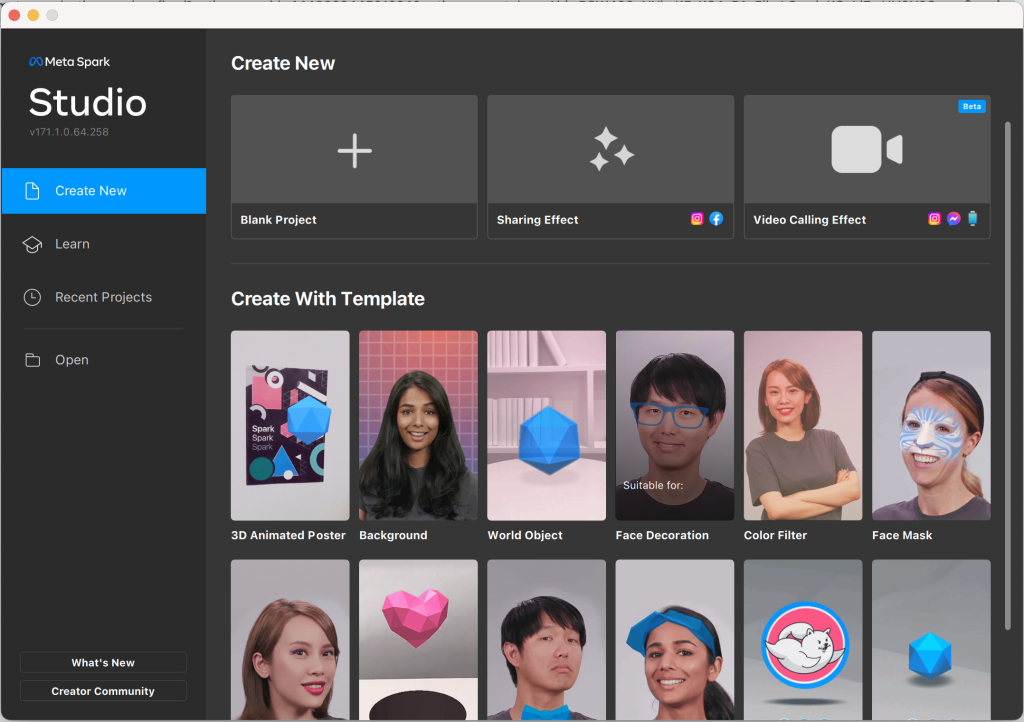
Sample projects are key to adoption
Most creators don't start from a blank scene - they start from a template and bend it. For a brand-new concept, that makes sample projects the way the concept spreads: every template is an opinion about what good looks like, and a set of patterns a creator will copy forever.
For world-facing AR I owned that question directly - determining the right size, shape, and number of sample projects to build, then standardizing the core design patterns they carried: how an effect finds a surface, how content scales to a room, what a user does when tracking is lost. The patterns we shipped in templates became the defaults of the whole category.
Past the face filter
World AR moved effects off the front facing camera and into the room, which is an entirely different design and opportunity space. World effects require their own kinds of editor simulations so you can proxy what space looks like. The failure modes and degradation paths change completely. And the creator needs a whole new mental framework to execute on successfully. The patterns we chose to provide had to deal with the table stakes, while providing the flexibility for creators to express themselves through their effects.
We operated under a model of proving value through prototyping experiences, and then refining our prototypes to become the foundational examples we would provide to creators.
It worked. World AR capabilities drove huge amounts of daily shares, and a wave of effects that had nothing to do with selfies.
Making video calls a shared stage
Tooling for effects that include everyone
Effects had always been single-player - an effect could only see the person wearing it. The Multi-Participant API made effects conversational, and that changed what creators needed to build one: a call is asymmetric. What you see of yourself is not what everyone else sees of you - they get the big-screen version, you get yourself small in the corner - and an interaction that feels right from one seat can be incomprehensible from the other.
So the tooling had to let a creator sit in every seat. I designed the creator-facing tooling that made the API usable: multipeer patches for sending state between participants, and a call simulator in the editor for testing both sides of the conversation - visually and interactively - without rounding up five friends. The distributed-systems questions underneath (who owns shared state, what happens when a connection drops mid-effect) all had to resolve into patches a creator could wire up in an afternoon.
Spearheading the path to Messenger
A platform capability isn't shipped until a partner surface turns it on. I spearheaded the partnership with Messenger to get multi-participant effects live in real calls - aligning two orgs with different quality bars, release trains, and definitions of done.
Group Effects launched on Messenger video calls and Rooms in October 2021 with more than 70 effects, from competitive burger-building to shared question games. Calling stopped being a grid of heads and started being a place you do things together.
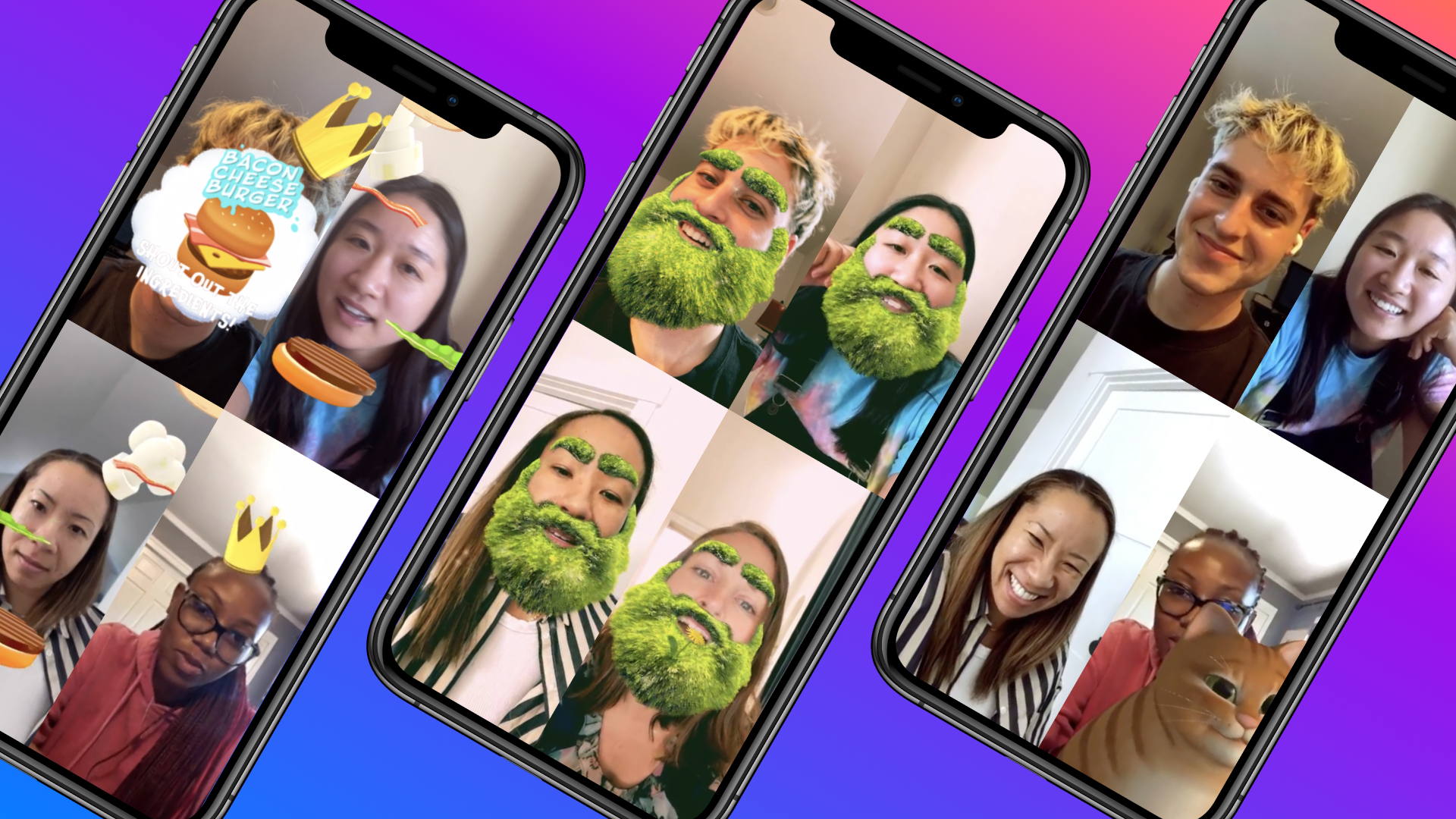
Platform work has many stakeholders, but that's what makes it fun!
Spark was an exercise in designing for two audiences at once. I've designed several B2B2C products - interfaces that had to work for a business's customers, sold to the business that served them. Creator platforms are the same shape: the creator is the customer, but the end user is the point, and every capability has to make sense for all parties involved before it ships. Does it drive user value? Does it drive business value for our direct customers? Does it make sense for our business and product? All questions that demand answers before moving forward.
Threading the needle between all the varying requirements was what made it so fun and rewarding to bring new functionality to the public during my time at Spark.